

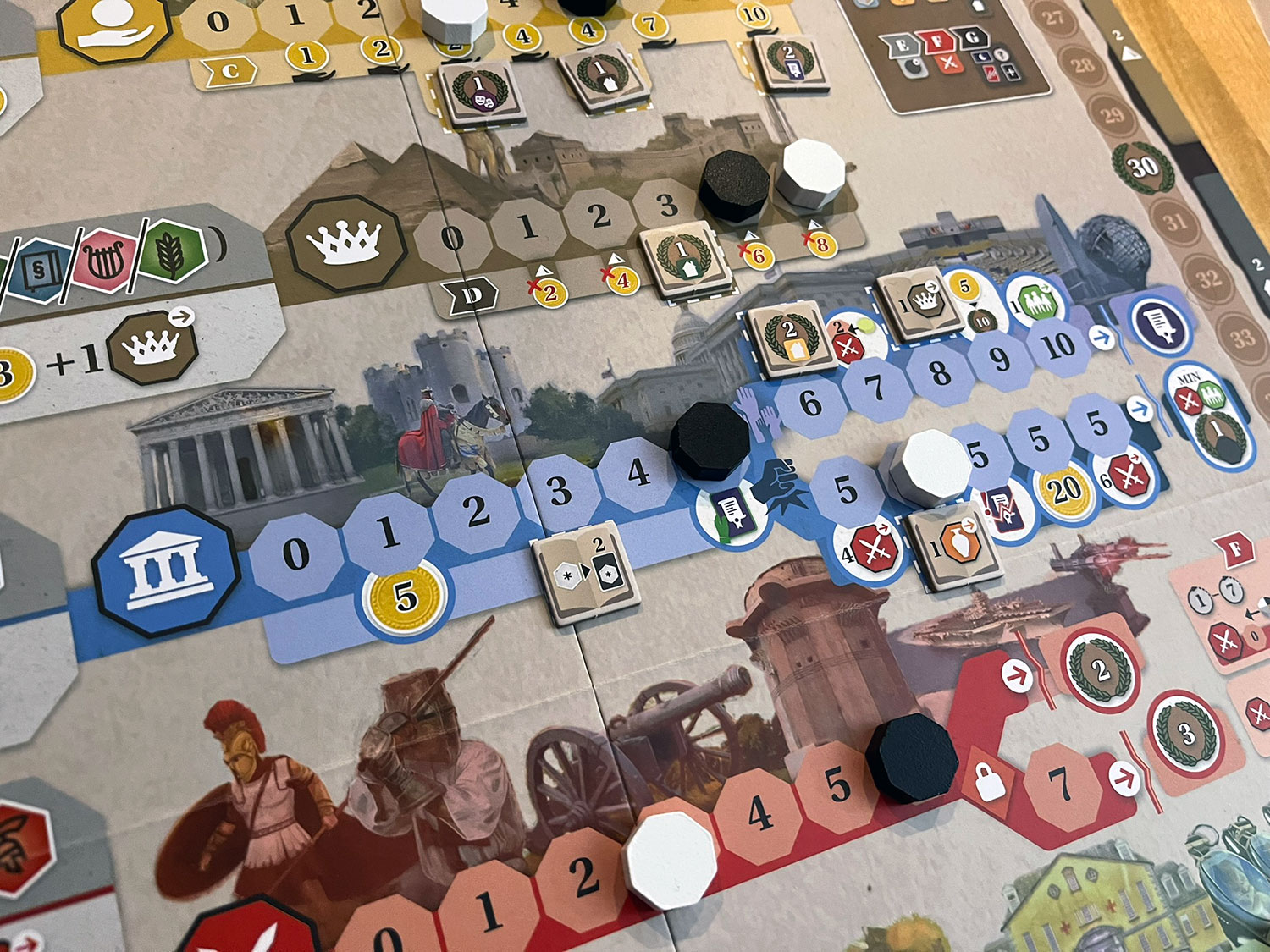
 In the great debate of Ameri-trash vs Euro-games, Millennia: Tracks of Time falls decidedly in the Euro-game camp. I mean, it has “tracks” in its title, and its main board is a paean to tracks with seven large, colorful ones proudly on display. This game knows its audience and unabashedly lays out its minimal luck, track-bumping, worker placement, and card-drafting design in plain sight.
What may be less obvious is that Millennia: Tracks of Time is also a richly thematic civilization builder. Designed by Orestis Leontaritis and Mike Georgiou and developed by Juma Al-JouJou (Clans of Caledonia), Millennia: Tracks of Time sees 1-4 players competitively develop their civilizations over 5000 years, condensed here to a mere 60-160 minutes. The signature feature of the game (besides tracks) is that all technologies and buildings developed by players eventually become obsolete, thus resulting in a constantly changing tableau of abilities.
Gameplay Overview:
Millennia: Tracks of Time is played over eight ages, starting with the Bronze Age and progressing through the Future Age.
Each age is technically divided into 7 phases, but most of these are fairly quick; the bulk of the decision-making and gameplay happens during the drafting, construction, and action phases.
Drafting Phase:
Each player has four draft markers, which they take turns placing. The two types of draft selections are:
- Technology: 14 different types are available for each age, represented by cards positioned among four different draft locations. Each location is also associated with a different income for the draftee. Technologies grant various tags and abilities
- Standard Actions: 7 different spots are available, 5 corresponding to track bumps. One guarantees research points for the round. The last grants a joker/wild technology symbol. None of these spots grants any income
Income from draft selections, tracks, etc… is taken following the draft.
Building Phase:
This is where most of your income gets spent. Players will take turns claiming either wonders or buildings from a common market.
- Wonders are very expensive but offer big end-game points
- Buildings are less expensive and offer smaller end-game points or temporary in-game abilities
Actions Phase:

Actions occur simultaneously and predominantly consist of track bumps earned from either standard actions or tapping specific combinations of tags on technology cards. Any rewards, abilities, or scoring obtained from track bumps are claimed immediately.
There are also a few non-track-related actions you can take as well.
Upkeep at the end of the round consists of eliminating all technologies and buildings that have become obsolete, and replenishing the table with techs, buildings, and wonders for the next age.
After 8 ages, points from buildings, wonders, and track-related achievements are added to in-game points to determine the winner.
Game Experience:
Millennia: Tracks of Time includes 14 different technology tags ranging from medicine and engineering—areas one might typically think of as “tech”—to areas like military, government, economics, arts, and agriculture. When players acquire new tech cards each round, this represents early adoption of those capabilities, which is a great, albeit temporary, advantage for your civilization. Acquiring a battle axe in round 1 (Bronze age) provides weaponry superiority up through round 3 (Medieval age). By round 4, however, pistols are considered the more powerful advantage until artillery, and subsequently tanks, become even more advantageous. It goes like this for each of the tech categories. Wheels are a big deal for transportation in the earliest age, until sailing and later railroads become more important.

Thus, all techs will eventually expire. Deciding which tech to acquire requires determining which tags you’d like, but also how long they’ll last (generally 1, 2, or 3 ages). Further complicating this decision is the fact that techs do not translate 1-to-1 for moving up the main 7 tracks in the game. Boosting your population requires both agriculture AND medicine tags. Improving on the trade track requires having an economics tag as well as either a transportation or an energy tag. As the game progresses, you’ll likely want to specialize in one area for a few rounds and shift to another track specialty later; each player’s tableau strengths constantly shift through the game.
What further opens the decision space is that some tracks/areas have overlapping tag requirements; maximizing research points requires a combination of engineering, transportation, and medicine (also needed for population growth and trade), and if you only have one of each tag, you’ll likely need to decide where to focus this round, unless you get creative and find a way to gain an extra tag. Of course, the simplest way of guaranteeing a track bump is to take a standard action in lieu of drafting a tech, which awards a one-time direct bump up one of 5 possible tracks, but when you go here, you lose out on valuable income, so it’s a trade-off.

Each track has its own distinct flavor that feels thematic regarding inputs and types of rewards. War is the most interactive track; it’s relatively easy to move up, but no immediate rewards are granted unless you hit the end of the track. In between each round, every player must slide their war markers back until the lowest player reaches zero. The message here is that war strength is strictly relative rather than absolute. In two-player games, war is a mutually destructive proposition. At higher player counts, it is easier to get a bunch of war points so long as at least one player mostly ignores war.
So the theming is pretty great. How about the replay value? The tech tags always come out in different arrangements, restricting how they get drafted. The board is also 2-sided with slightly different pre-printed track rewards on each side. Further, certain track rewards are always placed randomly. These factors alone make the replay value okay. The buildings and research cards make the replay value more respectable.

The game comes with 11 buildings for each age, and 2 per player come out each round. These can do anything from grant a unique end-game scoring condition, provide a bonus tech tag for a certain number of rounds, or endow unique effects like extending the expiration date on certain techs. The game also comes with 20 research cards, with 4 in play each game. Sponsoring these cards grants unique abilities like bonus points for standard actions or lowering requirements for the Influence track; they generally change the valuation of your actions.
How about critiques? Millennia: Tracks of Time is a long game. Even with the action phase being simultaneous, my first 2-player game took 135 minutes. I have since gotten it down to 90 and 120 minutes with 2 and 3 players, respectively. The game probably shines with three experienced players since war is more interesting and the draft gets tighter, but four players feels a bit too long.
Besides that, one track, the prosperity track, demands different tech combos each round and feels a bit random for such a long game, as some players will occasionally luck into having a much easier time fulfilling the requirement depending on the state of their tableau at that moment. Finally, Millennia: Tracks of Time has a fair amount of in-game upkeep as completely new buildings, techs, and wonders are transitioned each round, which some may dislike, even though the excellent built-in storage system makes this as painless as possible.
Final Thoughts:
Millennia: Tracks of Time is about as Eurogame-y as one can get on the Ameritrash-to-Eurogame spectrum. It’s a medium-heavy civilization game that puts some serious thought into the interconnections between technology and societal advancement while also nailing the concept of technological obsolescence by forcing players to manage an ever-changing tableau of abilities.
Combining a mixture of worker placement, drafting, and track-bumping, Millennia: Tracks of Time is for players who enjoy mild player interaction and don’t mind some upkeep between rounds and a lengthy playtime. It’s a far meatier experience than Rise and an overall better implementation of an evolving civilization than Ancient Knowledge. If you’re the type of gamer who can see a board covered in giant tracks and think, “this looks like fun”, then you’ll likely find Millennia: Tracks of Time to be a very fun time indeed.
Final Score: 4 stars – a drafting and track-bumping combotastic civilization-building Eurogame where technologies become obsolete, but the fun is constant
 Hits:
Hits:
• Excellent thematic and mechanical implementation of technological obsolescence
• Lots of crunchy Euro goodness
• Fantastic organizers included for the many card types
Misses:
• Playtime is a bit long, especially at higher player counts
• Prosperity track can feel lucky
• Moderate upkeep is necessary between rounds