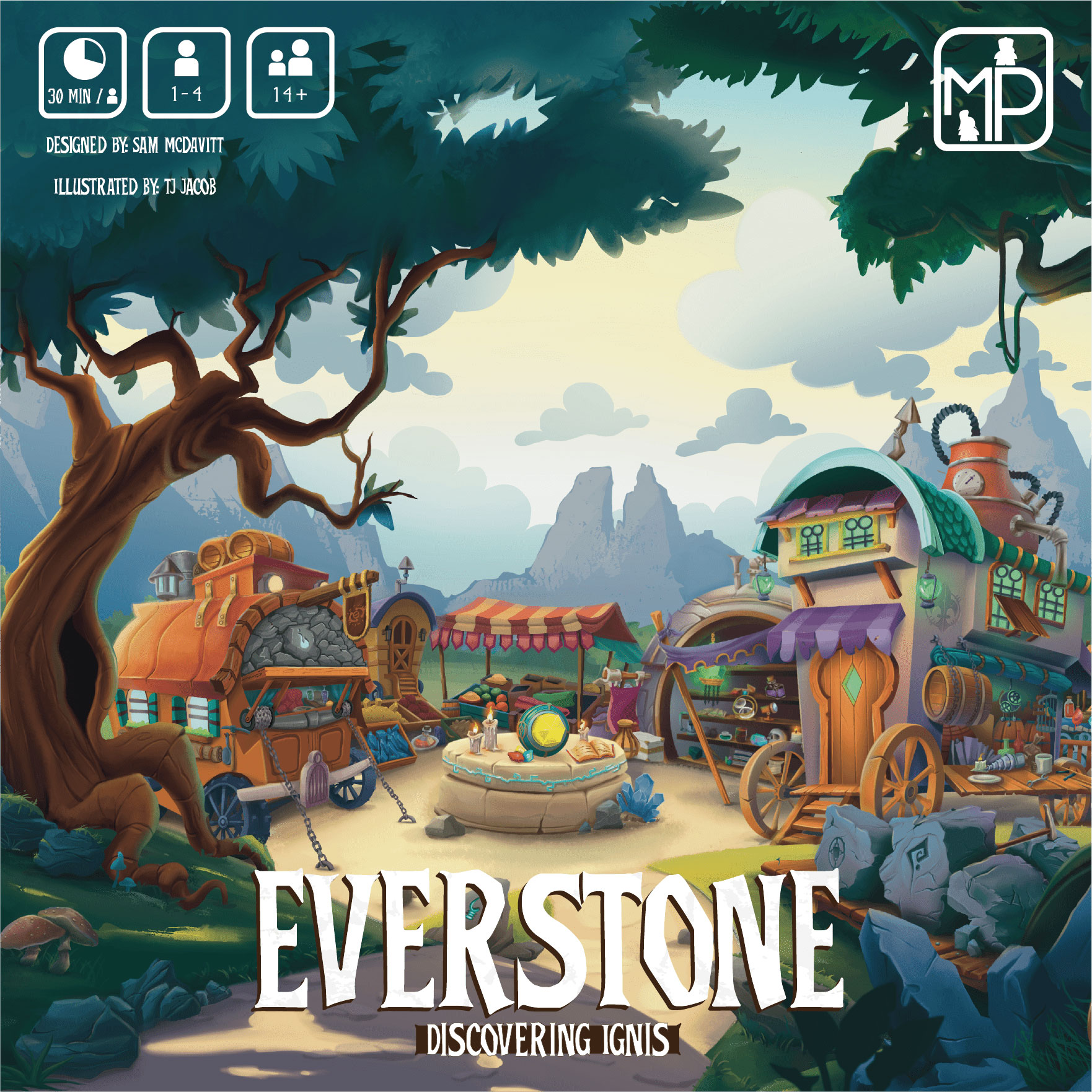
 Stone Age is a classic gateway Eurogame. Everdell sits in the top 50 games on BoardGameGeek.com. So surely a game called Everstone has to have some merit, right?
Ugh, intros are hard.
What really drew me to try Everstone: Discovering Ignis, was first-time designer Sam McDavitt’s description of multi-use cards, use of a Scythe-like action-selection system, and a flexible race-to-ten scoring mechanism reminiscent of Dune Imperium/Uprising. The cheerfully colorful artwork by TJ Jacob also helped.
In Everstone, 1-4 players have just discovered the magical city of Ignis, and they compete over 40-180 minutes in this medium-weight engine-building Eurogame to explore the valley and discover relics in an effort to garner the greatest reputation among the locals.
Gameplay Overview:
Everstone does not possess a set number of rounds; instead, players race to achieve 10 reputation points. The central loop of the game has players acquiring gemstone resources of three colors from various sources and trading them to repair relic cards that help them do various things.
All this is achieved through 4 main
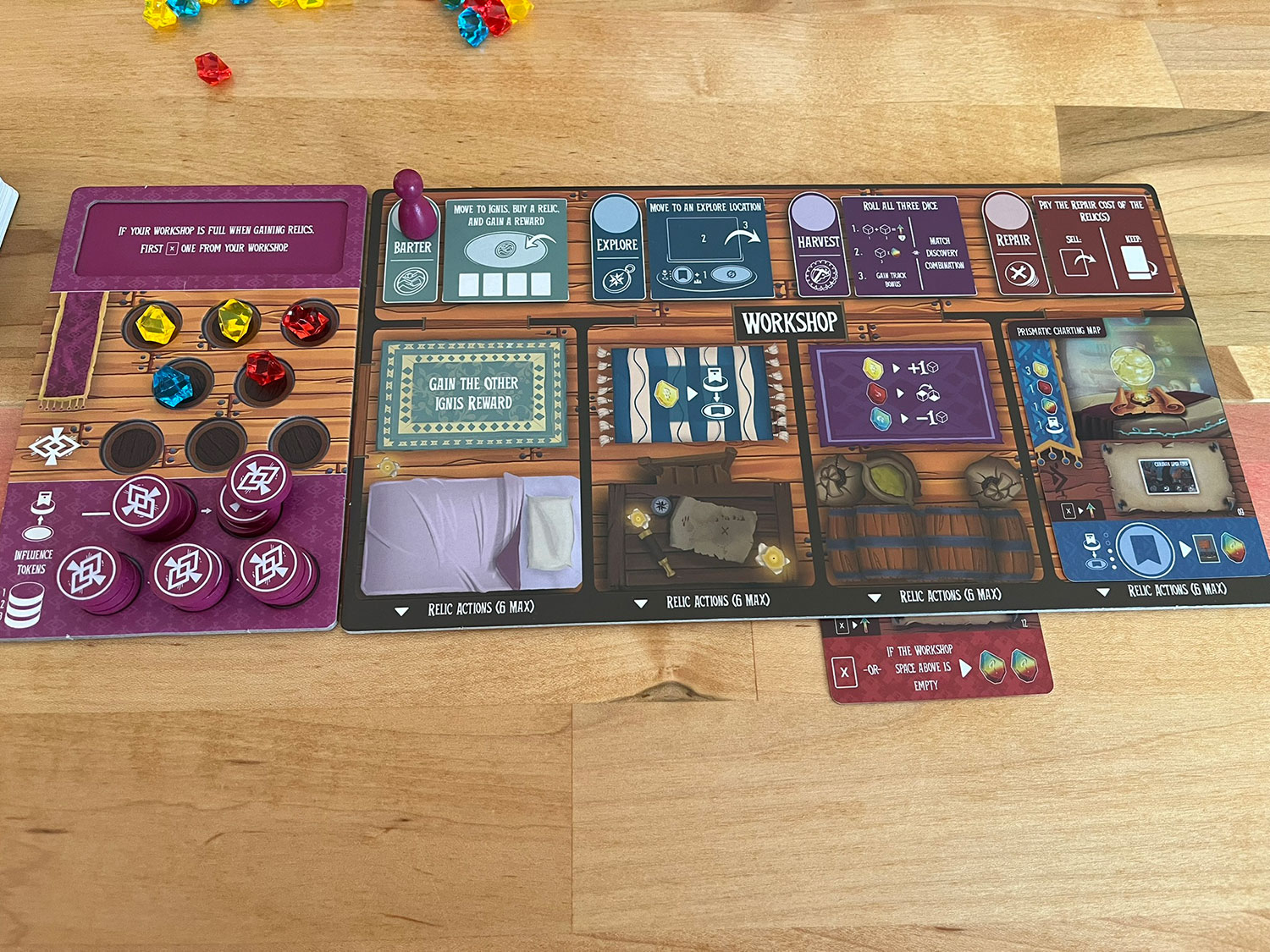
actions on individual player mats. Each of these actions is linked to a pre-printed secondary workshop action. Multiple repaired relic cards can be tucked under each action to grant multiple tertiary actions. It’s also possible to add caravan upgrade cards above to each action to precede them with special quaternary actions late-game.
The four main actions are as follows:
1 Barter – acquire a broken relic card from the shared market. This card will be stored in one of your workshops, thus temporarily blocking access to the secondary action.
2 Repair—Pay the cost to repair relics currently in your workshop a la recipe fulfillment. You may then tuck these cards for ongoing benefits, or “sell” them for one-time powerful rewards
3. Harvest—Roll three dice and use them to:
a.Top-deck a random relic in already repaired status if you achieve the correct numbers outright or via dice mitigation costs OR
b. Acquire resource gems of type and amount based on the sum of two dice and the pips of the third. Also, move up the corresponding gemstone track.
4. Explore — Visit a location on the board and perform its action. All players with influence at this location also receive a small bonus
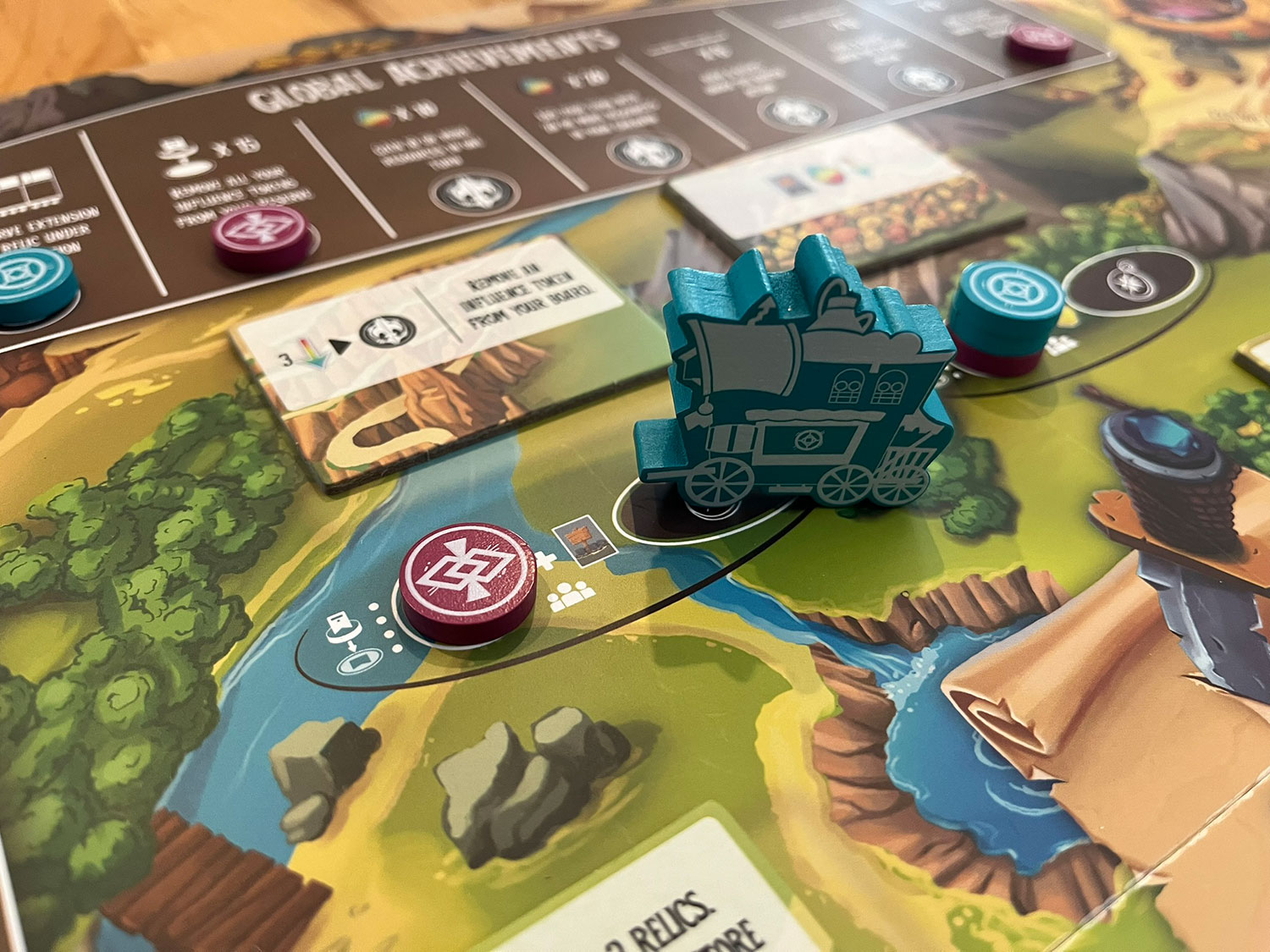
Reputation points can be achieved through various means, including:
- Being first to achieve any of the 8 shared achievements
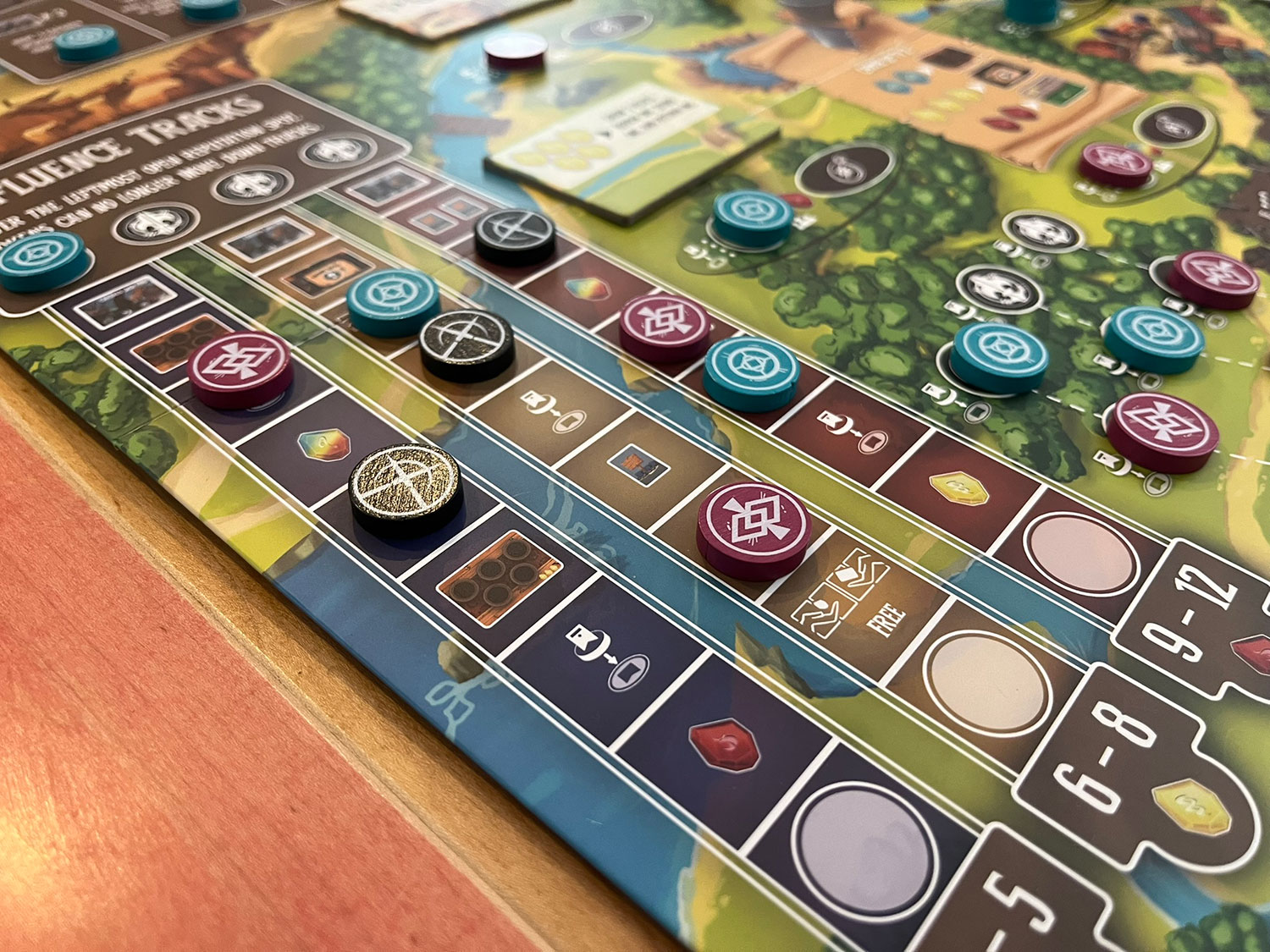
- Reaching the top of the gemstone tracks
- Fulfilling the pricey requirements at certain exploration locations
- Achieving personal quests
- Fulfilling the requirement on certain repaired relic cards
Game Experience:
If you like your games tight and punishing, Everstone may not be for you. Resource gems of 3 colors are usually easy enough to acquire through harvest and explore actions. However, the fact that the game is a race to 10 points, and many of those points are first-come-first serve, means there is a tension to get your engine going quickly, find useful synergies in the current game-state, and make every turn count. And the best way to do those things will change game to game and moment to moment.
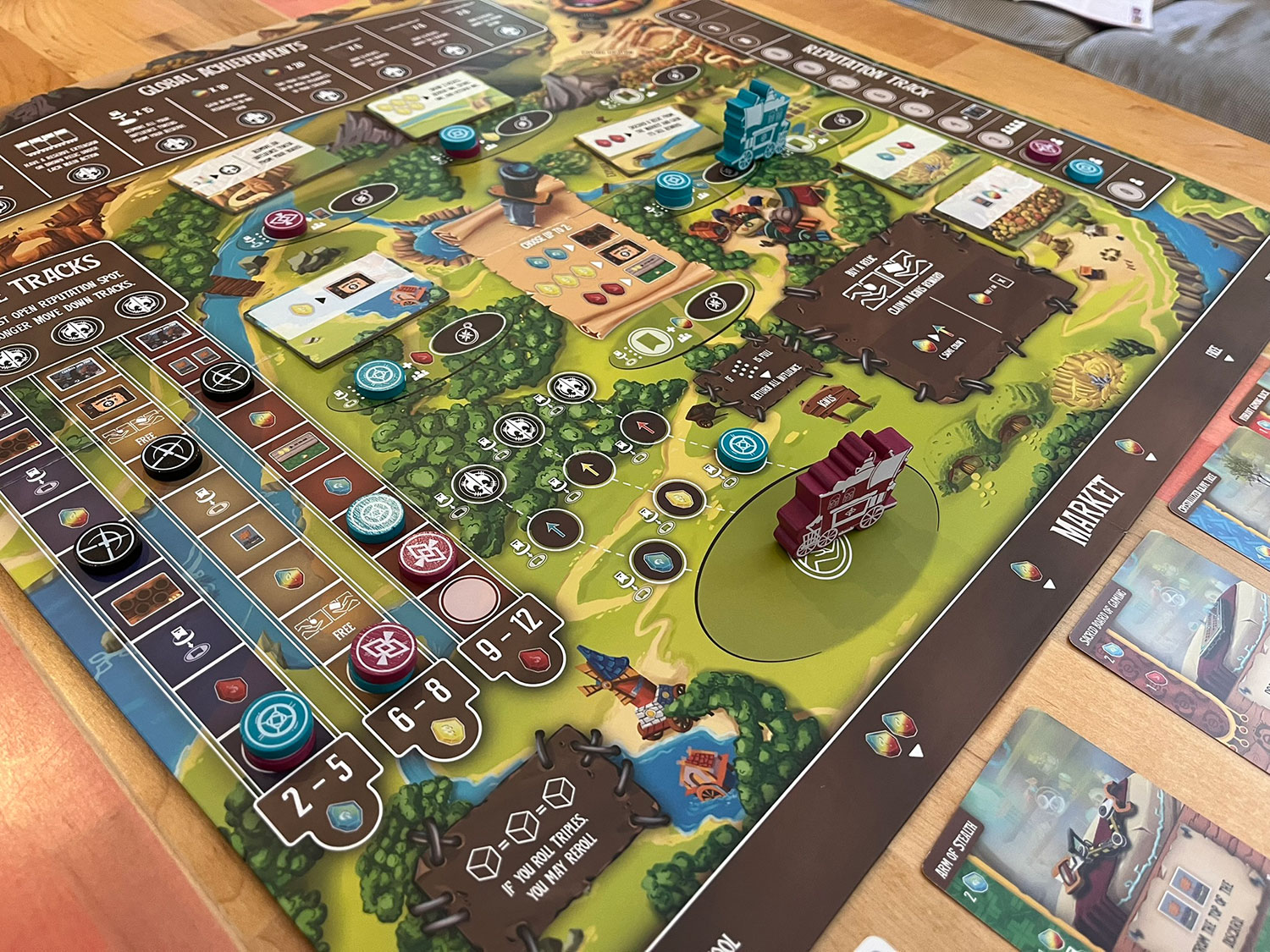
There are 80 multi-use relic cards, each with a unique combo of discard abilities, one-time “sell” rewards, and ongoing relic actions. Maximizing the benefits of available cards at any moment is key to doing well. Additionally, only 6-8 (out of 12) explore locations will be in each game (depending on player count), and these rotate around the game board during the game such that two are inaccessible for visitation at any given moment, and depending on board location, the associated bonuses will change. These constantly changing relic cards and explore locations are mostly where synergies need to be found.
If that’s not enough tactical variability for you, there are also 20 unique personal quest cards that will challenge players in various ways to earn reputation points. Additionally, there are 16 possible caravan upgrade cards. So while certain sources of reputation points are available in every game, those present at certain locations, on various relic cards, and through personal quest cards will change every game, making every play feel fresh.
Everstone is ultimately a mixture of several tried and true mechanisms: action
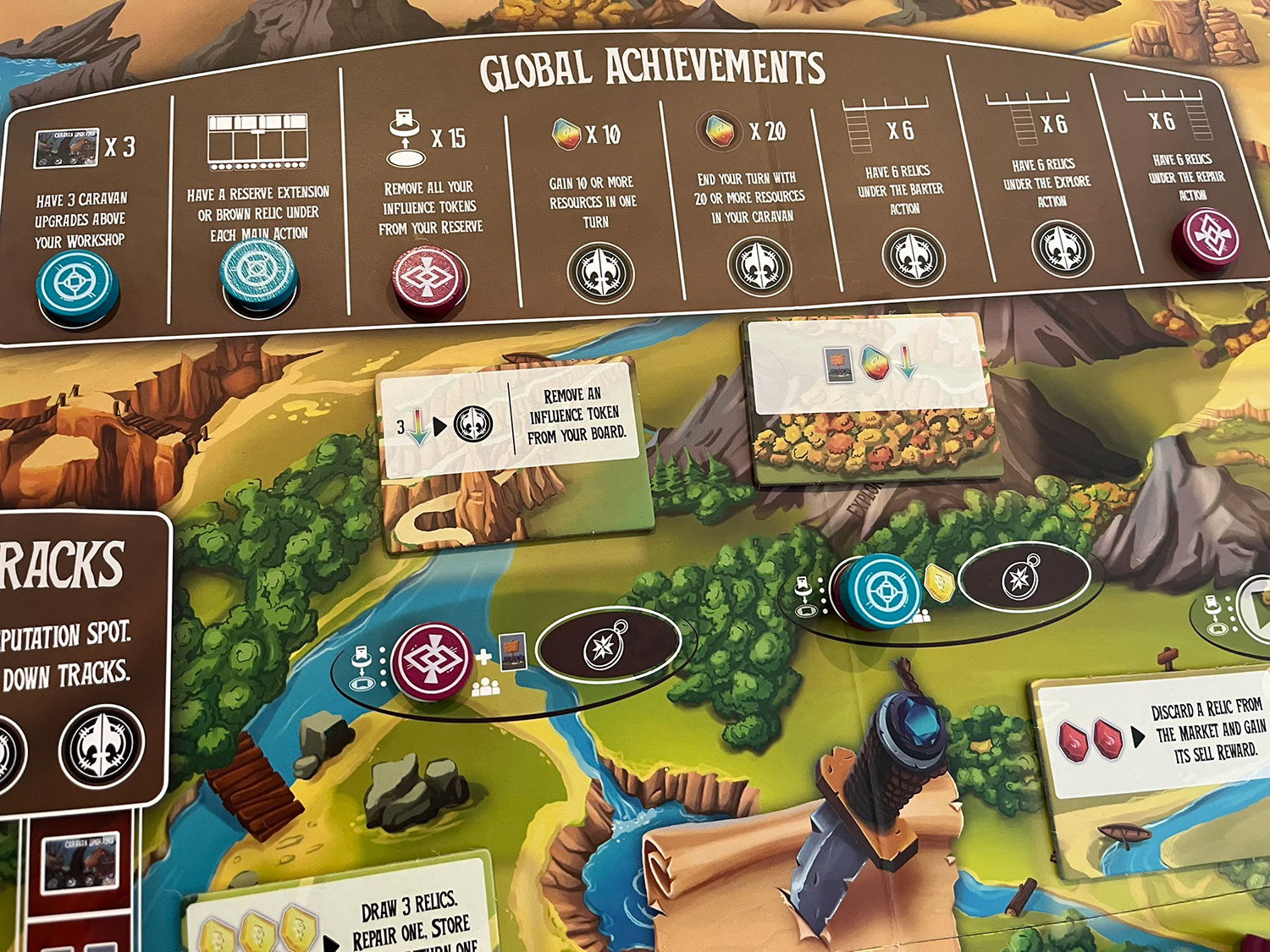
selection, engine-building, worker placement with bumping, recipe fulfillment, and multi-use cards. Two gameplay elements, however, stand out. The first is relic acquisition and repair. You will want to tuck relics to gain their various abilities, but the process of doing so usually requires temporarily clogging up a workshop space; thus your capabilities get worse before they get better.
Players can have anywhere from 0-4 relics stored in workshops at once, and while there’s an efficiency to repairing multiple at once, it may take time to acquire the requisite gemstones (and unlock space to store them), all the while missing out on secondary bonuses. Deciding when and which workshops to clog with relics, and how to move them around, is part of the game strategy.
The dual-purpose nature of Harvesting is also quite interesting. The opportunity to acquire a free, already repaired relic from this action seems pretty tempting, but there is a certain amount of luck in the dice rolls required, and players usually need gemstones of each color to improve probabilities—and even then, there’s no guarantee that the discovered relic will be useful for your current strategy. It can be fun to push your luck, knowing if you fail to get a free relic, at least you’ll still earn resources and a bump up a gemstone track that provides additional bonus rewards. The multiple possible uses of those
three harvest dice are so interesting that Jamey Stegmaier has a 4-minute video highlighting this mechanic.
Overall, Everstone has a fantastic arc. Resource gathering can feel slow at the outset, but with some well-planned engine-building, late-game turns can be combotastic and powerful. There’s even potential for a late-game super turn to result in several reputation points, thus unexpectedly triggering game-end. Some players may dislike such an abrupt end. It should also be noted that with so many unique relic cards, quest cards, location abilities, and caravan abilities, many of which interact with one another, questions do arise, and the rulebook does not do a great job clarifying these. You’ll need to find the appendix on boardgamegeek.com for descriptions of individual relic cards.
Finally, as with most games with thick decks of unique cards, some cards are simply better than others. For the most part, I’m fine with the variability of the relic deck; the specialness of a card is often dictated by other synergies of the game. A few of the personal quest cards, however, are unfairly easy or difficult and probably require some house rules to eliminate this imbalance.
Final Thoughts:
First-time designer Sam McDavitt clearly studied a lot of other great Eurogames and cobbled together some fantastic mechanics, including multi-use cards, action-selection, recipe fulfillment, and worker-placement with bumping, to create a new game that both feels familiar and yet has some clever twists of its own.
Above all, Everstone is an engine-builder that has players feeling accomplished and flush with resources, but also carefully calculating how to race to various achievements ahead of others. With 80 unique relic cards, in addition to a good selection of personal quests, caravan upgrades, and explore locations, replay value is excellent, constantly encouraging players to find new clever synergies and efficient ways to score 10 points. The main drawback is the rulebook, both for overall clarity and the fact that it does not contain an appendix explaining how most cards work. Nonetheless, when no rules questions arise, Everstone is everything I want in a great Eurogame.
Final Score: 3.5 stars—players must efficiently manage resources and multi-use cards in this fun-filled medium-weight race to 10 points
 Hits:
Hits:
• Interesting tableau upgrading mechanics
• Lots of unique multi-use cards for replay value
• Great production
Misses:
• Some relic cards could have used an appendix
• Lack of theme to pair with the cheerfully colorful artwork
• Some swingy personal quests