


 I love sprawling, involved games. Cooperative adventures that extend across several sessions, taking me from a 7th Citadel to an alternate Arthurian Universe. I also enjoy complex, competitive euros, such as Anachrony or Galactic Cruise.
Unfortunately, as I have gotten older, I have found that I have less free time due to responsibilities and/or my thrice weekly Jazzercise class. In recent years, I have been turning to games that scratch my cooperative or competitive itch (depending on the day) but play in an hour or less. White Castle. Leviathan Wilds. Marvel United. Stonespine Architect.
Stonespine Architect? Yes, I have a soft spot for Stonespine Architect. A) I love the game. B) I wrote the review for it last year. C) My daughter asks ME to play it with her. It’s a great competitive game that plays in less than an hour. Needless to say, I was very interested when Citizens of the Spark showed up for review. It is published by the same company, Thunderworks Games. It is a competitive game, and it plays in an hour or less. But will my daughter ask me to play it? Or has Thunderworks Games lost its… spark?
I’m sorry. That was awful.
Gameplay Overview:
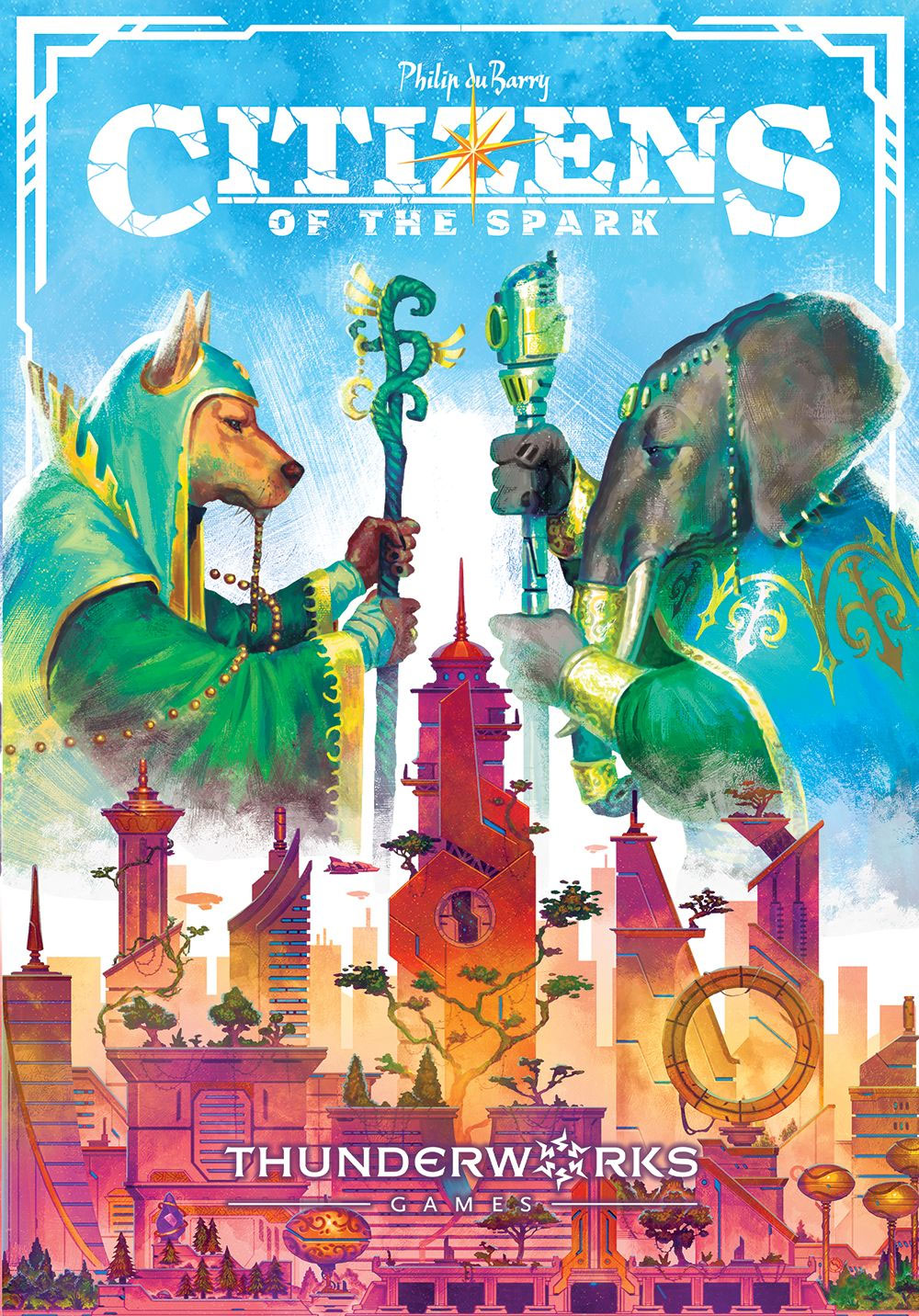
Citizens of the Spark is a competitive, tableau-building card game. Animals of the planet Fera were blessed with intelligence via a spark cosmic signal. They developed a grand society that was in harmony, until a prophecy was discovered that predicted one city would flourish, while all others would fall into ruins. One to five players will rule their own city, trying to attract the best and brightest anthropomorphic animals to determine the fate of their city in 45 to 60 minutes. Literally. That’s the play time.
Citizens of the Spark lasts a variable number of turns. Each turn consists of three phases, performed by one player:
- Attract citizens – the active player selects one of the three available groups of cards (each group will consist of two or three cards, depending on player count) from the assembly, collecting the selected cards and sparks (points) next to those cards, if applicable. New citizen types will be placed in a new stack, while matching citizens will be splayed on their respective stack.
- Perform an action (optional) – the active player decides if they want to activate one of their card stacks. If they do, one card is taken from the stack to indicate it is the active citizen, and then its action is resolved. Clockwise, each player decides, assuming they have the same citizen in their tableau, if they want to follow and perform the same action, immediately discarding the card after doing so. This continues until every non-active player has decided if they want to follow.
- Clean up – if the active player performed an action, their card is now discarded, then a spark token is added next to the two groups that were not selected, and replacement cards are placed in the assembly.
Then the next player completes their turn, and then the next, continuing until the draw deck runs out of cards. When it does, the discard pile is reshuffled to create a new deck, and play continues until the player to the right of the start player completes their turn (this guarantees that every player has an equal number of turns). Victory points are tallied and the leader with the most points is declared the victor… oh, and they can laugh manically as they witness their competition fall into udder utter ruin!
Sorry, part two…

Game Experience:
What made me wish I lived with anthropomorphic animals:
Drafting is probably the most difficult decision you will make during your turn. The beauty of Citizens of the Spark is that duplicate cards increase the power of the action when you take that citizen’s action. For example, one Merchant gains one spark per Economics icon in your city, but if you have two, you get two per icon, and three per icon with three copies of the Merchant. But you want to balance what you are drafting and not simply draft the same cards because you can create some fun victory point engines.

For example, the Trader has two economic icons. You may pursue drafting both types of cards to maximize the Merchant scoring opportunities. This is a simple example, and, of course, it assumes that your opponents won’t hate draft and that they are available for drafting in the assembly when it is your turn.
Another excellent mechanism is adding spark tokens to undrafted rows. You don’t like that double Outcast (a negative point citizen) row? It might be an easier pill to swallow with 15 spark tokens next to it! Balancing what to draft and how to build your tableau is very fun and (almost) always not an easy decision to make.
Speaking of not easy decisions to make, the design decision to make Performing an Action optional was a stroke of genius. Forcing a player to take an action by making it mandatory is a smaller decision space than having to not only decide if you will even take an action, but which card stack to activate if you do.
Why wouldn’t you want to take an action every turn? There are several reasons. First, you will be discarding the card by the end of the turn, so you will have one less citizen. Second, the action could benefit your opponents more than yourself since they can follow you (assuming they have the matching citizen). Third, you may want to draft your third citizen of that type in a future turn to max out the profits of your action. Deciding when to take an action versus delaying for another round is another difficult decision Citizens of the Spark provides.

Finally, the replay value of this game is off the charts. I played the “first time playing” set up four times with four different groups at 2, 3, and 4 players twice. Not one of the games was similar to others. First, the number of unique citizens included depends on player count. Second, the number of cards in each row in the assembly increases with four or more players. Third, 15 cards are discarded at the start of the game for lower player counts. What cards came out and in what order, combined with how players drafted and what their strategies were, created a unique game each time, even though I was using the same citizens. It only got better once I started using the randomizer cards to select which citizens would be included. You certainly get your money’s worth with this game.
What made me glad I am not living in a suburb filled with Merchant Ravens and Rancher Bulls:

While I have two “issues” with Citizens of the Spark, only one of them is not resolvable. At higher player counts, it can be difficult to determine icon count because of how far spread out players are across a table. Additionally, there is a nuance in the icons because the active player card is NOT discarded until Clean Up, thus, their icon count remains static during follower actions, while followers immediately discard their card after completing their action, potentially changing their icon count. Page 9 of the rule book covers this exact situation; however, that example covers only three people. It can be more complicated at five.
My other issue is… when are expansions coming out? There is room in the box. More must be coming soon. This game is made for expansions. Yes, there is already a ton of replay value in the box, but is more replay value and more varied card interactions ever a bad thing? This is not really an issue, obviously, but I am anticipating more clever designs with more anthropomorphic animals in the near future… I hope!
Final Thoughts:
I love Citizens of the Spark. I was hoping it would be another midweight game that played in under an hour, and I was not disappointed. What did surprise me was the replay value that the thirty unique citizens provided. For such a small footprint, the interactions can vary incredibly, and the decisions can be difficult, whether it is which cards to draft or determining if you will activate a citizen, and, if so, which one.
If this game sounds like you would enjoy it, I highly recommend Citizens of the Spark. For those of you on the fence, I would recommend at least trying it once. I think you will be pleasantly surprised. This is certainly another hit from Thunderworks Games!
Final Score: 4 Stars – An excellent card game that has significant replay value
 Hits:
Hits:
• Drafting citizens
• Action selection and following
• Replay value
Misses:
• Calculating icon counts can be difficult at higher player counts
• Expansion(s) not out













The strategic depth and competitive nature make it a must-try for board game enthusiasts.