This is a guest post from Katherine Kwong.
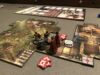
 “We eat first with our eyes,” goes the millennia-old saying. And Flamecraft’s delectable Sandara Tang art, cozy theming, and quality components are undeniably a significant part of the game’s massive table appeal.
But don’t let the sweet little dragons fool you into thinking this game lacks any depth. Flamecraft is not a twelve-course meal of molecular gastronomy and experimental flavor combinations; these worker placement, engine building, set collection, and contract fulfillment mechanics have all been seen before. But like a good home cook, Flamecraft takes some basic ingredients, adds its own flourish, and produces a deeply satisfying experience that welcomes all kinds of people.
Gameplay Overview:
Flamecraft begins with basic starter shops and dragons that aid players in obtaining resources, with more shops and dragons added as the game progresses. When players visit shops, they benefit from the shops’ abilities and the varying Artisan Dragons at the shops. Every Artisan Dragon of the same type has the same basic ability, such as granting resources, moving or playing dragons to different shops, or allowing players to trade resources for points.

The available shops and the Artisan Dragons at each shop shift throughout the game, providing players with asymmetrical choices when placing workers. As the game progresses, players are forced to balance taking advantage of a new shop’s opportunities, firing up an established shop for its benefits, and enchanting a shop to gain points and other benefits.
Enchantments require players to turn in sets of specific resources. They grant either a static reward of resources, points, and dragons or a scaling number of points depending on the number of complete resource sets the player has turned in.
Another key source of points is Fancy Dragons, which provide benefits during or at the end of the game based on anything from having a certain number of a specific type of tokens to how many starter dragons are at their corresponding starter shop.
The game ends when either the Enchantments deck or the deck of basic Artisan Dragons runs out, rather than after a set number of rounds.

Game Experience:
Flamecraft shines brightest in two key areas: its asymmetry and variety. While the starter shops and basic Artisan Dragons don’t change game to game, many other parts of the game do. Only 10 of the 28 unique shops available with the base game are used each game (along with the 6 consistent starter shops), significantly altering what types of new locations will become available each game. Because the types of dragons present at a specific shop partially determine a player’s action options, Artisan Dragon abilities that swap dragon locations or allow dragons to be played in other locations can change the effects of worker placement locations from turn to turn.
Once players are more experienced, the game provides an entire additional deck of Enchantments (with more complex costs and benefits) and Companion Dragon cards that grant players helpful one-time abilities. In combination with the numerous possible combinations of unique shops and Fancy Dragons, this gives the game substantial replayability.

Flamecraft’s theme is convincingly woven throughout the game’s artwork, components, and gameplay. This is a great game for people who love worker placement but are having a hard time convincing non-gamers to pretend little colored cubes are wizards, rogues, and clerics. The lighthearted theme and superficially simple action choices, along with the chunky wooden dragon player tokens, neoprene playmat, and brightly colored artwork, make people want to play this game. Everyone from 8-year-olds (despite the game officially being 10+) to family elders have played Flamecraft and enjoyed themselves, even if they were previously unfamiliar with worker placement mechanics.
Fitting with the cozy theme, Flamecraft does not have any true attack elements or player elimination. But the game isn’t full multiplayer solitaire, as there are several small points of interaction between players. Most significantly, the engines players build aren’t private—any shop and its dragons are available to (and modifiable by) each player on their turn. This forces an almost push-your-luck-like balance between optimizing the potential benefits of an action cascade and triggering the engine before someone else uses or disrupts it. Getting the right combination of resources at the right time can mean a big points swing, but only if someone else doesn’t get there first.

Flamecraft does fall a little short in a handful of areas. First, the rulebook’s explanations and organization are not the most beginner-friendly, which is a pity for a game that is otherwise pretty accessible to newcomers. Friends who are more casual board game players tried to play just off the rulebook and confessed they weren’t really sure if they were playing correctly, but they did enjoy themselves.
Second, the game rules don’t do much to keep the game equally playable at all player counts. The solo mode is a bit underwhelming, and the only changes for 2-3 players vs. 4-5 players are the number of Artisan Dragons in the deck (to trigger the end of game faster with fewer players) and giving an extra resource to the fourth and fifth player during setup. Confusingly, despite including complete player materials in 6 different colors, the game has no official 6-player mode, a disappointing missed opportunity. While the full range of player counts is reasonably playable, the game is usually best with 3-4 players.
Final Thoughts:
Come for the enchanting artwork, stay for the satisfying gameplay. Flamecraft effectively follows the classic worker placement game recipe with a dash of asymmetry and a classic smorgasbord of scoring options. The flow of new shops and shifting dragons keeps in-game choices fresh, while the different options for shops, scoring, Enchantments, and Companions keep replays from becoming stale. Overall, an accessible but still thoughtful game for many types of players to enjoy.
Final Score: 4.5 stars — a very solid asymmetrical worker-placement game that welcomes newcomers to the table while serving up enough complexity to interest more experienced players.
 Hits:
Hits:
• Constantly shifting asymmetry
• Impeccable theming and aesthetics
• Variations increase replayability
Misses:
• Basic powers do not vary
• Rulebook flow may confuse beginners
• Minimal player count calibration

 About the Author: Katherine appreciates elegant mechanics, satisfying components, engaging themes, and well-written rules. She happily plays with a wide range of ages and experience levels as long as the game takes less than an hour to set up and isn’t Candyland.