


 I love area control games: El Grande, Rumble Nation, Blood Rage… the list goes on. However, I am quite mixed on Chip Theory Games’ design efforts so far: Too Many Bones is too convoluted; Cloudspire feels half-baked; Hoplomachus: Victorum is the best solo experience I’ve ever had; and The Elder Scrolls: Betrayal of the Second Era is my most anticipated game (when I win the lottery and can afford it).
So can Chip Theory Games make a great area control game? Let’s take a look at Wroth and see what makes it tick.
Gameplay Overview:
In Wroth, players take control of different cultural factions vying for control of regions in the Drudgeon Peninsula. Players race to become the first faction to cross a 30 Victory Point threshold, but at the end of that round, the faction with the most Victory Points wins. Unless faction-specific abilities say otherwise, the only way to score Victory Points is by controlling region(s), “dominating” a region (meaning controlling a region with no competition), or by having certain Elite Troops of that faction in a region they’re controlling.

Each round of the game has several phases, but the main focus is on the dice drafting of the game. Each round, a certain number of dice are rolled, and players will draft the dice on the table to perform basic actions. Then, once all the dice are drafted, players are given the choice of several supplementary actions to take, in addition to an action on one of their drafted dice. These basic actions are things like moving troops, deploying troops, battling, or gaining Corra, the game’s currency.
Corra is used to deploy each faction’s Elite Troops. In addition to some of these Elite Troops being worth Victory Points, each different Elite Troop has different abilities that thematically fit each faction. If you’re a tanky faction, then you’ll get units that are shields that take all hits first, and a unit that heals at the start of each round.

Game Experience:
I’m not going to bury the lede here: Wroth is my current front-runner for my Game of the Year.
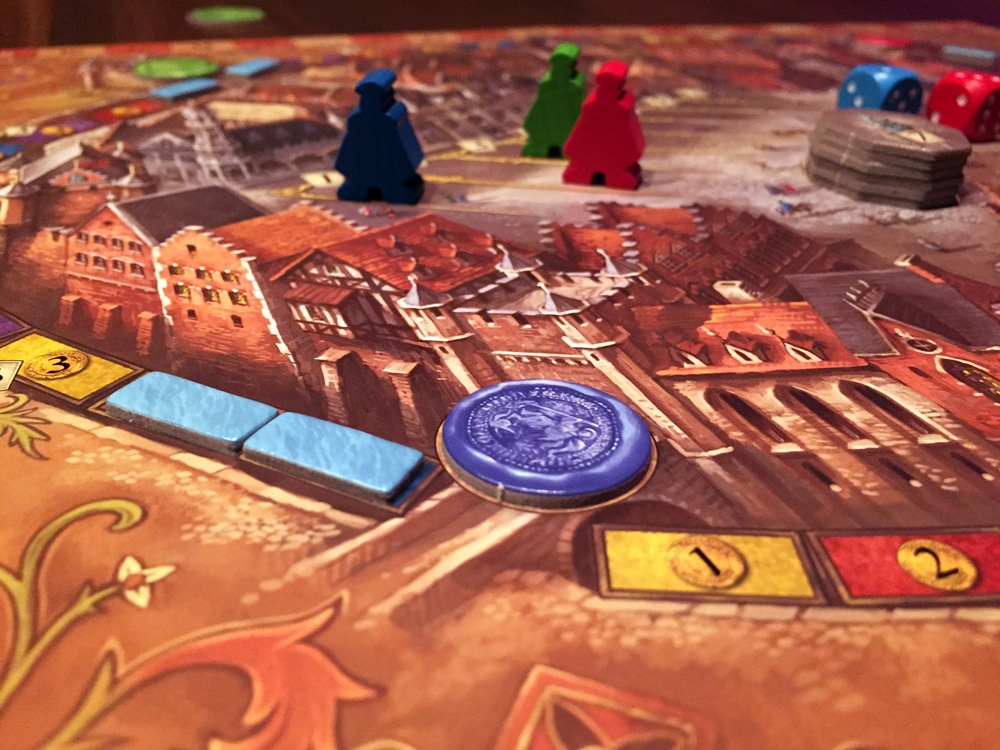
First, let’s talk about this game’s production. Manny Trembley has been an artist I’ve loved since Radlands. But with Wroth, he takes his art to an industry-defying level. The campaign defined it as “neon-soaked fantasy” and the BoardGameGeek banners describe it as “it looks like a unicorn barfed on the table”. These descriptions do not even begin to describe just how ingenious and evocative this art truly is on the table. Pair that with the stellar production design from Chip Theory Games with neoprene, plastic cards, custom dice, and unique plastic minis for each faction, and you have a game that not only is in competition for best art and components for the year, but one that doesn’t do so at the cost of playability or affordability.

As for the gameplay, it reminds me of some of the classics of the medium in its simplicity and depth. Learn the dice symbols, the movement rules, the “one-for-one” combat system, scoring, and each faction’s abilities for the game, and you’re set. And with completely open information, there are no surprises. And yet, even though the rules are clear and the information is open, there is no draw to analysis paralysis because what you can do on your turn is refreshingly simple. And, if you’re playing with three or four players, any unclear decisions can be thrown to the table for juicy political talk.
Speaking of player count, each player count offers its own unique game with its own unique challenges. A two-player game is a tense game of give-and-take, with smart players taking some rounds to be “rebuild rounds” to make a big swing in future rounds. A three-player game is a delicate balance of politics and constant changing of alliances. A four-player game is either a stand-off in a phone booth, with everyone watching each other for someone to finally make a big play, or the hammer fight scene in Oldboy, where it’s just total carnage in a confined space for an hour.

My criticisms are few, but impactful for certain players. I see the different player count playstyles as a positive, but I know that will rub some people the wrong way. Some faction abilities can feel overpowered, but in my opinion, in a game where every ability is overpowered, and the game lasts four to seven rounds, an ability is only overpowered if it’s not checked. But again, the aggression needed to really knock someone down a peg is not for everyone. I also feel the inclusion of the co-op and solo modes is completely unnecessary. I don’t think they’re anywhere near as revolutionary as the main player-versus-player mode, and if you’re looking primarily for a solo or co-op game, please skip Wroth.
For me personally, though, my only criticism is with the rulebook. With Version 1.0, there is one crucial rule that is blatantly wrong, which is frustrating. There are also quite a few faction interactions that are not commented on and are unclear how to resolve, leading to jumping to FAQs and forums. Based on what I’ve read from Chip Theory Games, however, they’re already working on a new draft of the rules, so hopefully that resolves these issues.
Final Thoughts:
In a market where games feel like they’ve lost harsh player interaction and have focused on over-production over quality gameplay, it’s refreshing to see Wroth come out and be a fresh take on a beloved genre and breathe new life into it. With the best art and production I’ve ever seen, paired with small, genius twists to a tried-and-true formula, area control fans should not sleep on Wroth.
Final Score: 5 Stars: My neon-soaked, unicorn-vomit Game of the Year.
 Hits:
Hits:
• Top-tier art and production
• Brilliant, small tweaks to area control
• Player interaction of the late ‘90s/early ‘00s
Misses:
• Rule error in the rulebook
• Fringe faction interactions are confusing
• Unnecessary, uninspired solo & co-op modes







What is the missing crucial rule?
The dice that you can play as units can sometimes score you points. The current draft of the rules state that if those dice are PRESENT you get the points, whereas what the rules will state in the future is that when you’re PRESENT AND WINNING that region you score those points.