

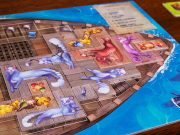
 Me: Man, I love Vantage. If it were not for The Elder Scrolls: Betrayal of the Second Era, it would be my runaway winner for game of the year. I wish I could express to the world why I like this game so much. Unfortunately, you already covered Vantage. If only there were some way to do a second review for Vantage…
Tony: You know what… I’ll make this one-time exception for you. You can write your own review for Vantage. Besides, the average number of views for your reviews is that of a small metropolis. Remember, you do hold the record for the most views for a single article at BGQ!
Me: Awwww shucks, thanks, Tony. You mean THIS article, right? Top 10 Cooperative Games
Tony: That’s the one! Maybe your Vantage review could match those views! Do you think you can do it?
Me: I do not know, but I sure can try.
Tony: That’s the spirit!!
That is the true story of how Tony 4-D chessed me into writing this review of Vantage.
Gameplay Overview:
The gameplay in Vantage is pretty unique. The rulebook walks you through the basics and the turn structure, and then just kind of……ugh. I cannot plagiarize Tony. Here, read his Vantage Review for the Gameplay Overview as well as his other thoughts, if you are so inclined. I just want to get to my thoughts on the Game Experience.

Game Experience:
Note: This review will be as spoiler-free as possible.
What made me wish I were on a malfunctioning spaceship, hurtling towards an unknown planet:
The biggest change to Vantage, and one of the reasons I wanted to have a second review on BGQ, is that Vantage was released on Rulepop after Tony’s review was published. For me, this is a HUGE improvement to a game I already loved. Most importantly, it is free. All the storybooks are online and at your fingertips on your phone, tablet, or computer. It also includes quick references, detailed rules, a FAQ, and errata for the cards. All storybook errata will already be updated on the website; however, you will still need a physical copy of the Book of Vantages, as it is not included on the website.

The reason I think Rulepop is such an improvement is two-fold. First, it significantly speeds up the game. You no longer have to search for the right storybook, then the correct entry. You simply click on the storybook, type in the entry number, and the cost and description of the action pops up on your screen. But the best part? The results are blurred. Once the action is resolved, you simply tap your screen and can then read the result. No more forgetting which entry you were reading and having to find it again, not that that ever happened to me with the physical books…
Which brings me to the second improvement Rulepop provides: solo play is SO much easier. No need to worry about seeing other entries while scanning for the one you need to read to yourself. Dealing with reading the books was my biggest concern for playing solo. I simply type in the entry and go. It is so much more efficient and has led me to playing this game solo way more than I thought I would because I am no longer tied to physical books.

For me, Vantage’s open world is its biggest selling point. You can do whatever you want from your vantage. You can perform any of the actions presented on the card, or you can leave where you are and go in one of four directions (MOST of the time). If you do not want to do either of those options, you can interact with cards in your inventory or the game board. Exploring what the world has to offer, and your options within it, is what makes this game so fun. The different biomes on the planet, the beautiful vantages (and card art) you will discover, along with the number of items, companions, and unique interactions you will have, create one of the most unique board game experiences I have ever had.
Which brings me to my third point. The number of options that you have will create emergent stories you will not soon forget. In one game, you could be a plant collector. Another, you might be a zookeeper. In one game I played, I hardly moved from my original starting area, while my gaming partner was being thrown around the world almost involuntarily. I am trying to be as ambiguous as possible and do not want to spoil anything. But many times I read what my action result was, and I was left thinking “what else has been included in this game?”

Finally, I love the dice action system. You may (or may not) have heard that you succeed at every action you take. That is correct, and I fully embrace this design decision. Why? Because it is fun knowing that you will most likely succeed at what you try to do. Wait, I thought you said that you succeed at every action? You do, however, you must roll a number of dice based on the action you take, and any dice that are not rolled as a blank or a setback must be assigned to one of your cards, or you will lose the resource (morale, health, or time) on the unassigned die. Failure occurs when you do not have the resources to spend because they are at zero.
This is where cooperation can help. Your fellow players can absorb a die on your behalf if they have an impact slot available. This is important because the dice pool is a static size during the game, equaling eight dice plus two per player. As you absorb dice on cards, the dice pool becomes smaller, but your flexibility for bad die rolls becomes restricted. How do you clear your slotted dice? When a player attempts an action that requires more dice to be rolled than are currently in the dice pool, all dice are removed from cards, the dice pool is reset, and THEN the player rolls the correct number of dice. Balancing when to absorb dice, when to take a resource loss, and when to try to rest the dice pool adds a level of strategy to this game that I really enjoyed.
What made me wish I was playing Elder Scrolls: Betrayal of the Second Era:

Jamey, designer of Vantage, has already said there will be no expansions for Vantage. Everything is already included in the box. While some will love hearing that, a part of me wishes there were ways to add more to the game. While it would take a great many games to see everything, after ten games, I have started seeing locations I have been to in previous games. To be fair, I usually do not remember what action(s) I previously took, but the vantage will be familiar. I do not want this game to ever become familiar.
The only other downside, and the same one that Tony mentioned, is downtime during higher player counts. I would not recommend playing with more than three players. With actions being read aloud and decisions being made, having four or more players has, at a minimum, two people doing nothing for at least two turns in a row. Two players, for me, is its sweet spot, with solo coming in a close second, and three players bringing up the rear.
Final Thoughts:
I have already discussed why I love Vantage. Let me tell you the true story of my non-gaming friend Tom. I promise this one is true.
Tom comes over about six times a year to play games. He prefers cooperative games but loves minis and dice chuckers, such as Massive Darkness and Death May Die. I broke out Vantage. He looked disappointed that, while there were dice, there were no minis. We started our game. He was instantly hooked. Multiple times, he looked up at me and said, “How did they come up with this??” When the game was over, he simply said, “Again.”
Gamers complain about rehashed mechanisms, repetitive themes, and games that care more about mountains of plastic rather than great gameplay. Those same gamers need to play Vantage. It is such a breath of fresh air and an experience unlike any other. Not only is it one of the best-designed games this year, but it is also the most unique game of 2025. I truly believe that, at a minimum, you will enjoy your time and will likely find yourself purchasing the game. Vantage is simply phenomenal.
Final Score: 5 Stars – The best open world board game ever published
 Hits:
Hits:
• Rulepop
• Open world
• Emergent storytelling
• Dice system
Misses:
• No expansions will be made
• Higher player counts






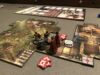



The solution for higher player counts is to assign each player they book of their own colour to read for anyone else. For themselves, they pass it across the table to be read.
Everyone is engaged, and remember everyone can help out in tasks with skills, so multiplayer interaction is almost constant.