


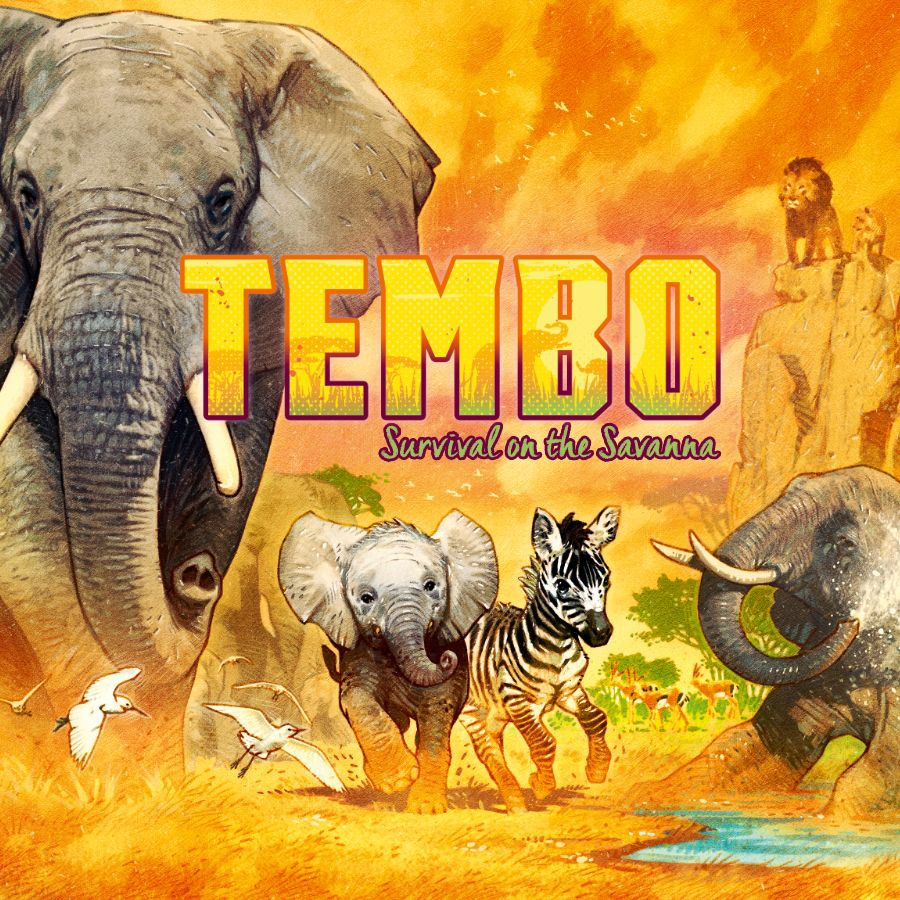
 The first things that drew me to Tembo Survival on the Savanna were the art by Vincent Dutrait and the table presence. The theme of elephants traveling across the Savanna also intrigued me. Tembo, which means elephant in Swahili, is a cooperative game that plays one to four players in about 30 to 45 minutes.
A-weema-weh, a-weema-weh, In the savanna, the sprawling savanna, the lions eat tonight… Wait, what?
Gameplay Overview:
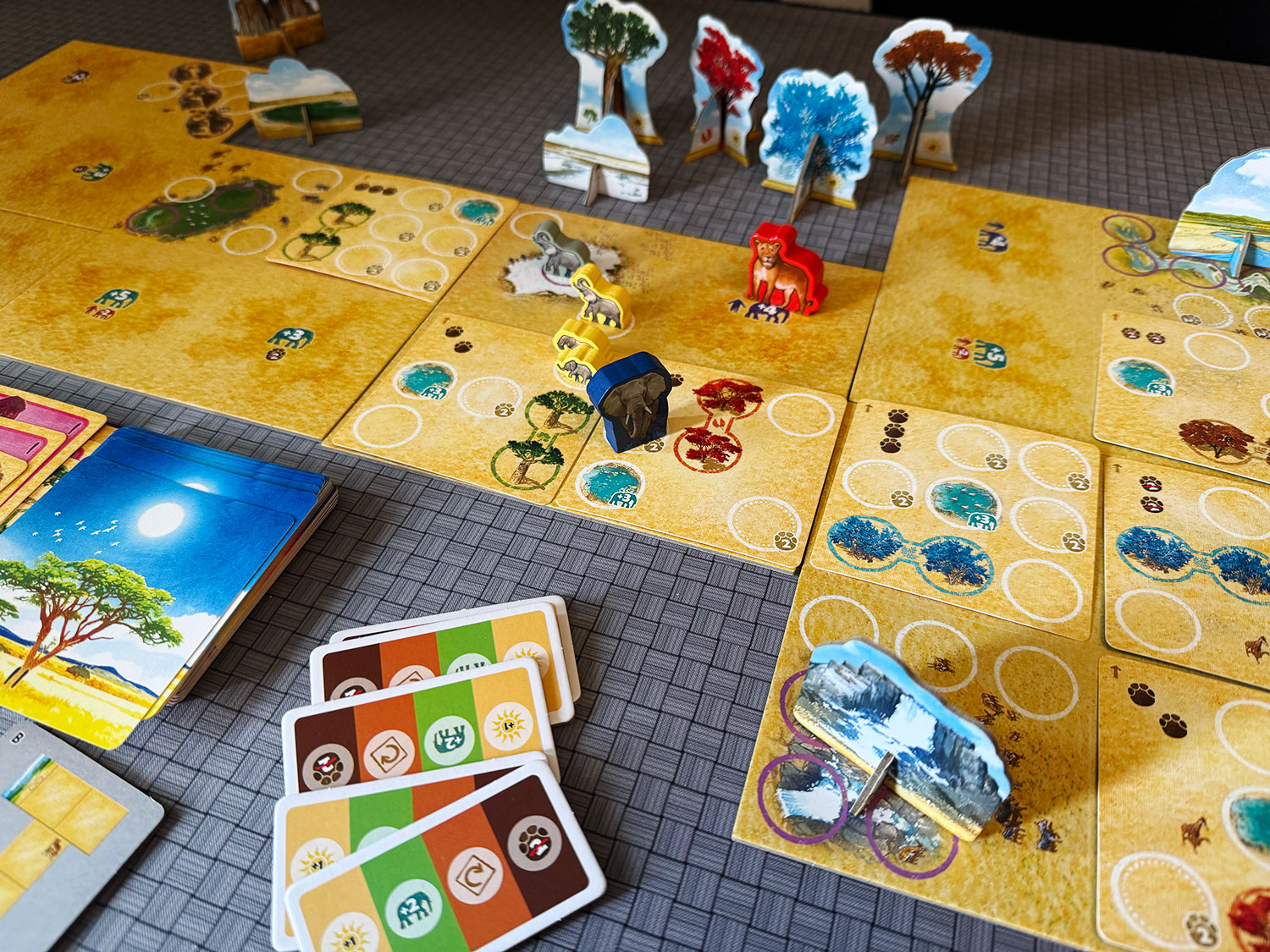
Each player starts with a hand of three cards and three rested elephant pieces on their colored player board. On a player’s turn, they can do two actions with some nuances to be discussed later:
• Build a Savanna – Take a card from your hand and play it on an open square on one of the tiles. Covering the symbols on the tile grants benefits such as all players gain two rested elephants, the current player gains 5 while another player loses 2, picking another player who gains four elephants, or gaining three and then placing one elephant, ignoring rough terrain.
• Place Elephants – Spend a card from your hand to place elephants matching the pattern shown on the card. Some of these cards ignore rough terrain; more on that later. But you must have enough rested elephants to play the whole card. You can also play a card to play a single elephant. Elephants placed must be adjacent to another elephant or the matriarch.
Those two simple actions have many nuances I want to discuss, with the biggest being that some cards must be played in a specific orientation to the player playing them. The areas marked as rough terrain require two elephants fill those spaces. There are also water spaces that grant you three rested elephants, like they’re multiplying like Gremlins in water.
Additionally, one of the requirements to win is to visit six landmarks, adding a wrinkle to your plans to take the shortest path. Some trees grant energy when both spots for the tree have been filled.
At the end of your turn, draw cards until you have three.
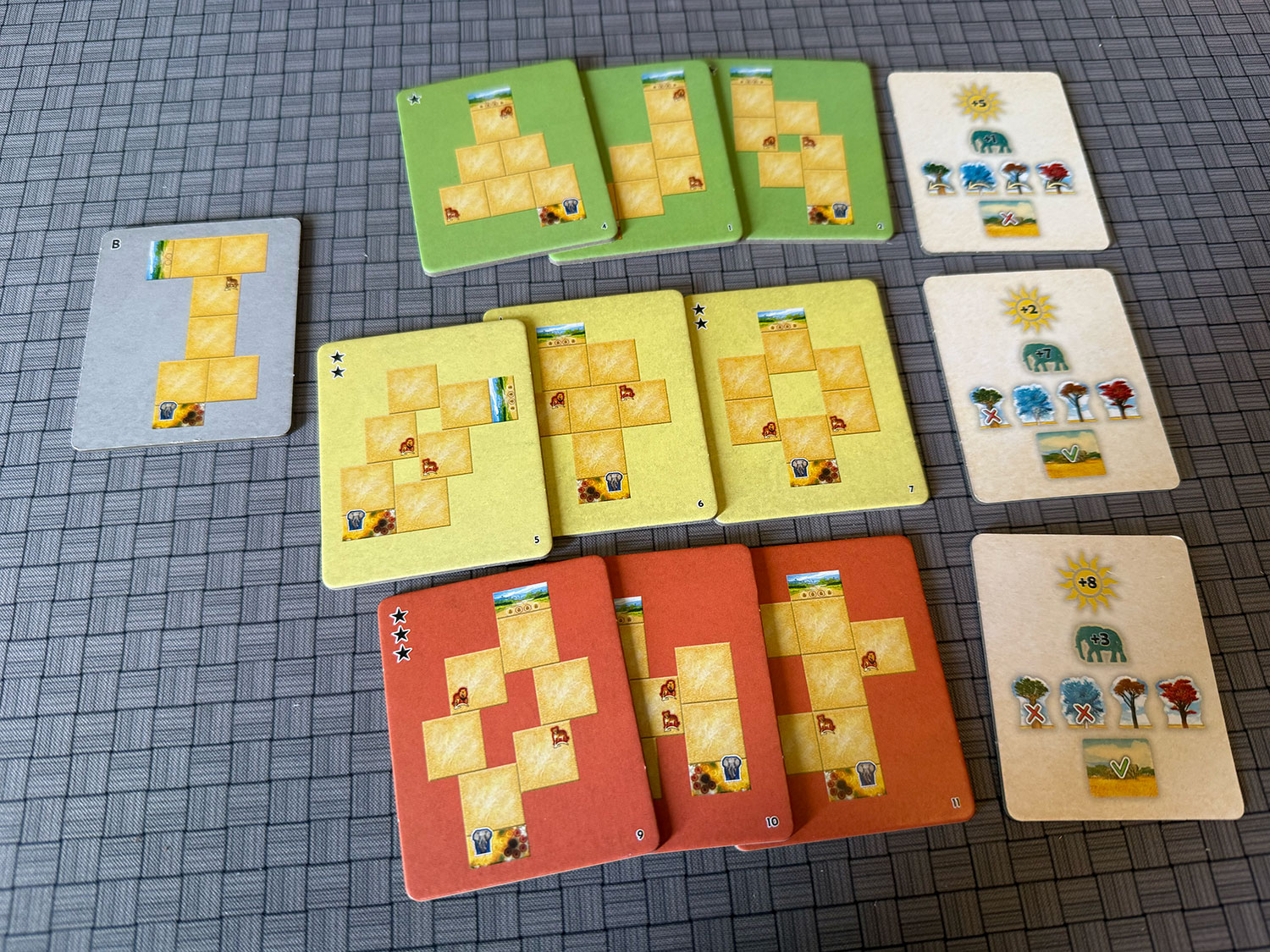
Energy is used to pay for matriarch cards, which are shuffled throughout the deck. Placing one of those allows you to move your matriarch elephant to a spot adjacent to other elephants, then pick up all the elephants on the board and move them next to each player’s board, set the trees that have been spent for energy back upright, and lastly reduce your herd’s energy by two. Running out of energy is a way to lose. Not a big deal, except if you ever have two of these cards in your hand, you immediately play it, doing all the steps above, but it costs five energy.
There are also lion cards that stand up a lying-down lion or move the two lion tokens one space towards the elephants. Then, remove all elephants in that space from the game. Because the lioness goes first, it’s possible the lion could pick a different space, potentially wiping out a large portion of your herd in one turn. Then lay the token down as the lion sleeps tonight.
But if both end up next to the matriarch, the players lose.
The players need to place two elephants on the destination board to win, while they can all lose if any player runs out of elephants, the energy tracks hit the end, or a player can’t draw a card from the deck at the end of their turn.
Game Experience:
After reading the rules and understanding the byline, I tried to explain the game to my wife, who was enamored with the cover art and the cute little meeples.
“You play cards to either add them to the board or place elephants.”
*Happy giggles as she fiddles with her elephant meeples*
“The lion cards move the lions, and if they end up in the same space as an elephant, they’re removed from the board.”
*With a horrified look on her face* “But the baby elephants…”
I started stammering, “uh, they joined a circus… or went to live on a farm…”
“NOOOOOOOOOO!!!!”
Taking a page out of fellow reviewer Brian Biewer’s playbook: And that’s the true story of why I’ll be paying for therapy for the foreseeable future after asking to review Tembo.
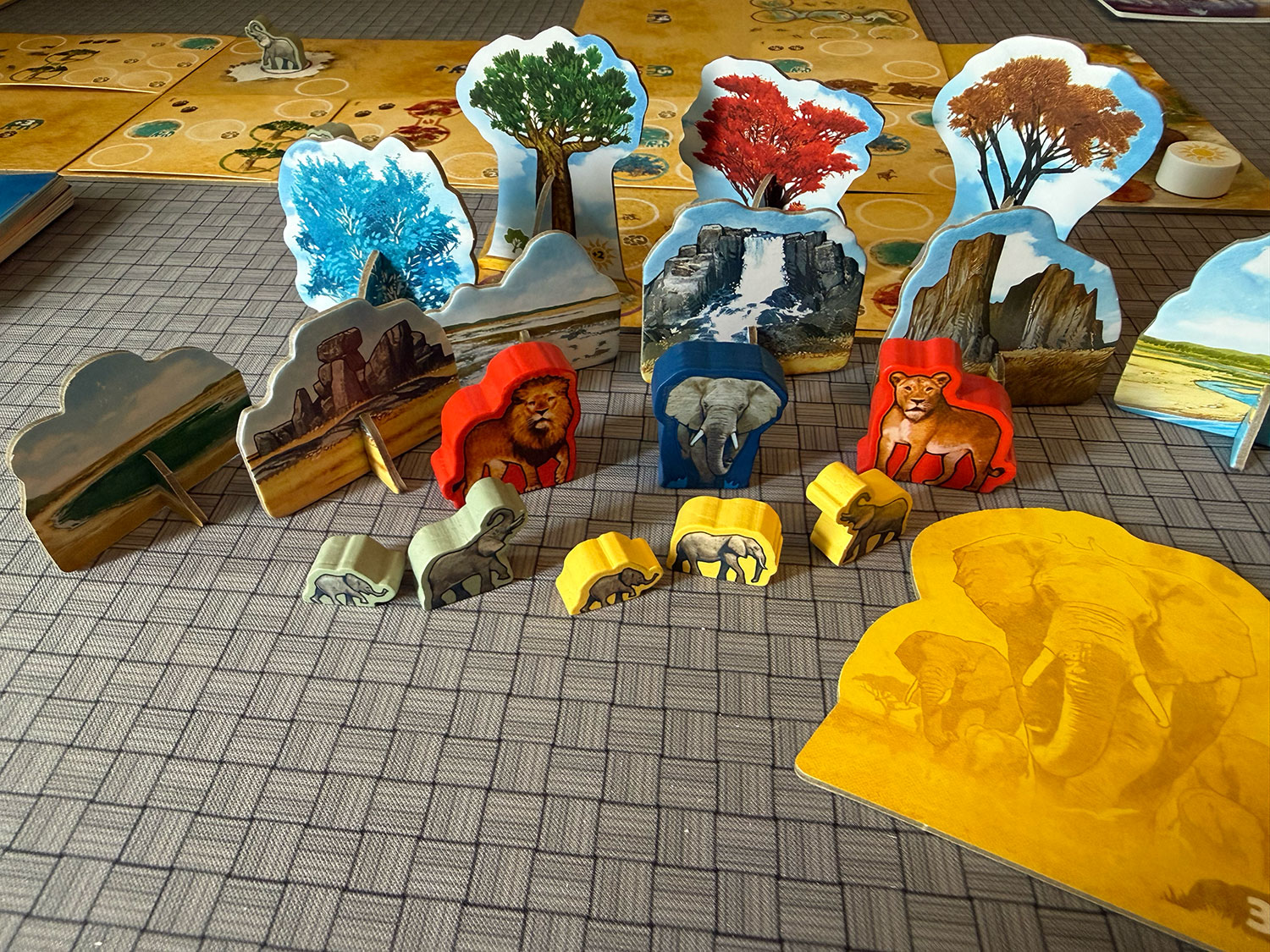
Jokes and spousal emotional trauma on the side, Tembo is a clever cooperative game of managing resources (energy and rested elephants) while also trying to make the most efficient path through the varied board layouts and, possibly most importantly, trying to avoid being on the menu. Thematically, it doesn’t make a ton of sense as lions very rarely go after a healthy adult elephant, let alone six, but game mechanics are gonna mechanic.
Even on the easiest levels, I found this to be a challenging game. There’s some luck if destination locations are in less convenient locations. Also, who knew elephants had bucket lists? Managing rested elephants and trying to move the herd was an interesting challenge with decisions like do I waste a turn to play a card to place my last elephant, or place a card on the savanna to give someone else more elephants? Even a well-timed savanna card can grant elephants to one player without costing you, or anyone else, as someone with zero rested elephants can’t lose any. Overall, you can play the game tactically or strategically, and I’d assume planning further ahead makes the game easier.
Matriarch cards are a double-edged sword, as you need them to pull elephants back to use again, but at the cost of energy, which sometimes encourages pushing your luck to get more trunks for your bucks. But if you ever have two in your hand, they activate immediately, and the energy cost is 5 instead of 2. It’s possible to have two in your hand and then draw two more, which would effectively end the game due to energy loss.
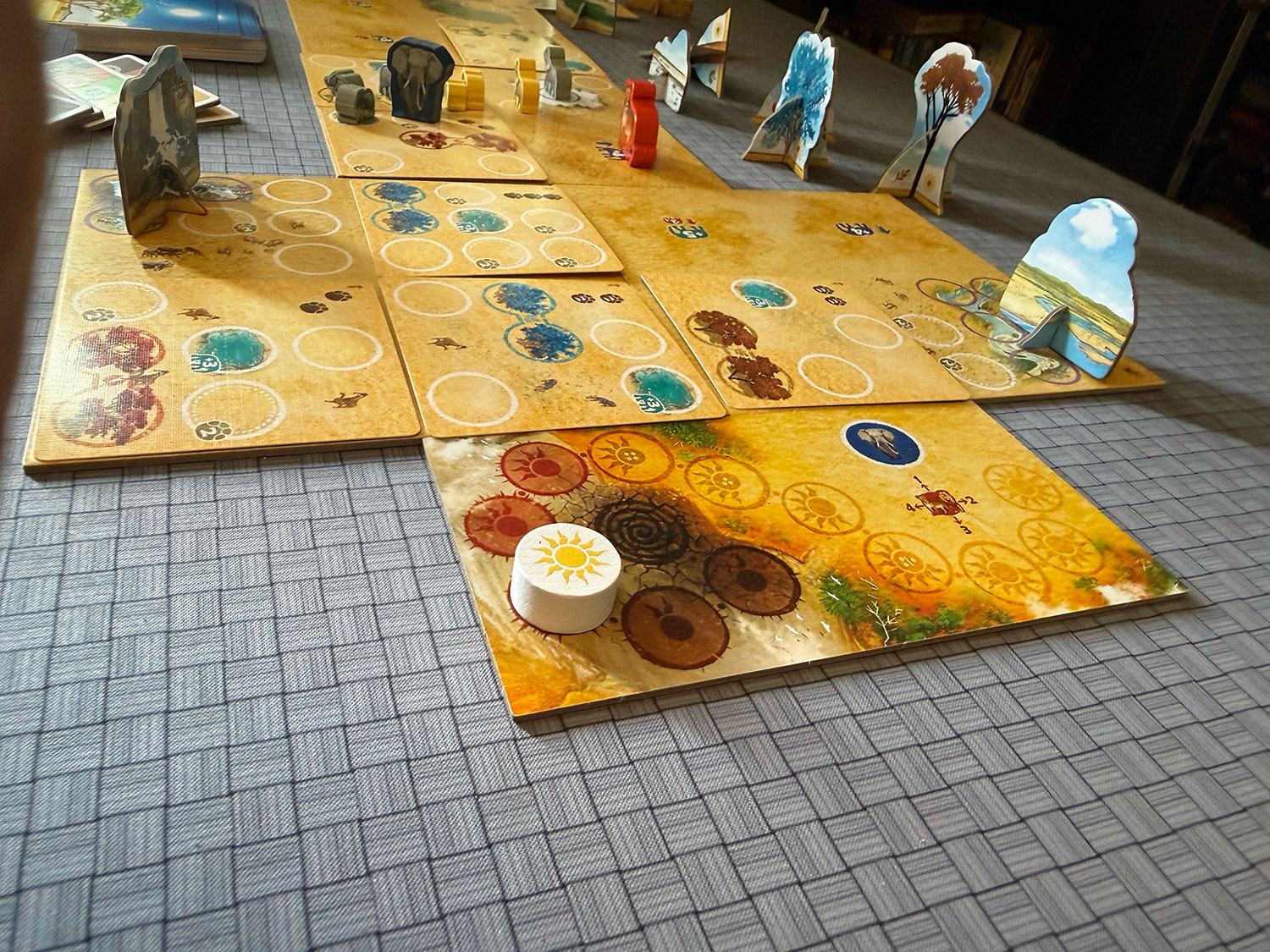
The other way you’re likely to lose is when the lion cards activate, which has the two tokens move and then remove all the elephants, except the matriarch, from that zone. Even a couple of snack-downs will really hurt your ability to get to the destinations. I’ve also won with only a handful of elephants left between the players.
The game does a good job getting you started with some starting cards and between 0 and 5 helper cards, which can allow you to make some progress before lion and matriarch cards enter play. Additionally, you’ll get the same number of tokens, which can each be turned in for a single effect as another source of boosts. Each of the three decks (10, 11, and 12 cards respectively), representing different parts of the day, has a different makeup of matriarch (4/3/2) and lion (3/3/4) cards.
I like the concept of the three-to-five-scenario long campaign as well as the varied difficulty levels, including using events to shake things up, which makes the game scalable from easy/family weight to hardcore. The campaign adds some wrinkles by drawing two scenario tiles (opposite side of the journey tiles) and then selecting one of them and gaining the benefits, which could be more elephants, more energy, trees starting to be knocked down, and whether events are used.
Final Thoughts:
Tembo is a neat resource management game. The puzzle of managing rested elephants, your team’s energy, and how other players’ elephant pools look makes for an interesting and challenging experience. It’s simple to explain and, at least for me, hard to master. I appreciate the varied setups and ways to scale difficulty. This also means there’s a good amount of replay value in this small-to-medium-sized box. But if losing elephants to lions makes you uncomfortable, you may want to skip this one.
Final Score: 4 Stars – Tembo is a solid and challenging puzzle-like cooperative game about elephants on an unforgiving savanna.
 Hits:
Hits:
• Interesting push your luck with matriarch cards
• Challenging resource management-based cooperative game
• Several ways to modify difficulty
Misses:
• Randomized setup can vary in difficulty
• Can end abruptly with bad luck
• Theme may hit some harder than others