
 War games aren’t usually my go-to choice for game nights, but I’m a big fan of Undaunted and recently enjoyed the card-based Plains Indian Wars. Quartermaster General: South Front covers a part of WWII that I find intriguing: the campaign for North Africa and its effect on the war in Europe.
This game is part of the Quartermaster General series that emphasizes the importance of supplies and support in a war effort. A prior release covered the East Front in the same two-player format. It’s a card-based game that plays fast and demands the optimal use of limited units.
Quartermaster General: South Front, designed by Ian Brody for Ares Games, is a two-player game that takes about two hours to play.
Gameplay Overview:
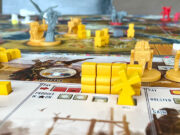
The game is played on a map of the Mediterranean that displays the coasts of North Africa and southern Europe. Stretching across the map is a 16-season round counter, beginning in Summer 1940, and ending in Spring 1944. There are scoring phases at the end of each of the game’s four rounds.

The game starts with some land, air, and sea strength for the British, Germans, and Pact countries, with the American forces joining the action mid-game. The unit count is low and must be used efficiently.
Each player has one turn per round, which includes two movement phases, an action phase, and a supply-line check. The action phase is played with cards. Both decks have a subset of cards labeled “Late War” that are withheld until mid-game.
Victory points are scored by counting control markers on the important (starred) territories. Control of these areas before each scoring phase is critical to winning the game.

Game Experience:
Having played both sides, I found the relative positions and strengths of each side quite different. The Axis powers have a well-fortified but single supply route out of Rome, which is a deep vulnerability until they activate Bulgaria. The Allies are weak in manpower and equipment and must make hard decisions about where to focus their efforts until the American forces come into play mid-game.
The single turn per round made the game feel as if it moved along quickly, but there are several phases for each turn, which piles up the strategic decisions.

Having multiple uses for cards was great: during the action phase, you may use a card’s main text or discard cards for a small set of standard actions like “Conscription,” which lets you deploy units. In addition, during your or your opponent’s action phase, you can discard a card to use its reaction text. Reaction text may be used offensively, to sustain an attack, or defensively, to repel one.
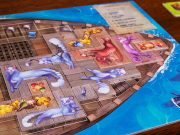
The earlier games in the series didn’t have a full naval component. The ability to use ships for transport is useful, as you are never far from a landing site; however, sea battles vary from land battles enough that there was a lot of double-checking the rulebook. Players familiar with the series may not find it necessary, but this was my first experience with a Quartermaster General game, and I thought the rulebook could be tightened up: rules for deployment have several special cases, scattered through the book. The player aids are also missing some useful information.

The asymmetric Axis and Allied forces felt very realistic. German powers are strong at the start, but the Axis is hampered by a smaller deck and must conserve its resources or face devastating consequences. Out of three games I played, the Axis player twice used the entire deck before the end of the game, leaving them with essentially no plays in the final round. The Allies are thinly spread at the start, but the American entry into the conflict makes a huge difference over time. By the time the Axis side has used most of their resources, the Allies are in high gear, deploying fleets, infantry, and aircraft at a fast clip.
Final Thoughts:
Quartermaster General: South Front is a quick and flexible card-based game exploring the fight for control of North Africa and an entry point into southern Europe through the lens of strategic supply lines across the Mediterranean.
Final Score: 3.5 Stars – Quick but engrossing card-based game; tight resources call for difficult choices.
 Hits
Hits
• Fast-paced
• Asymmetry makes for unique challenges on each side
• Board and map design keep the focus on strategic advancement and deployment opportunities
Misses:
• Tight card play can be frustrating – a huge risk to the Axis side if the deck gets depleted
• The numerous edge conditions for rules could have been organized better
• Player aids could be enhanced